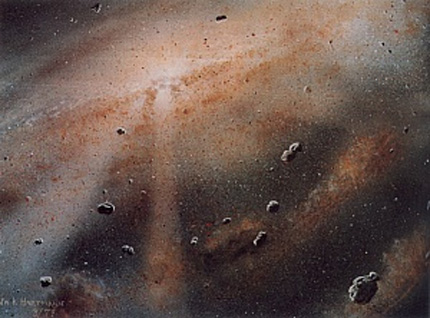
The Solar System formed 4.568 billion years ago from the gravitational collapse of a region within a large molecular cloud. This initial cloud was likely several light-years across and probably birthed several stars. As is typical of molecular clouds, this one consisted mostly of hydrogen, with some helium, and small amounts of heavier elements fused by previous generations of stars. As the region that would become the Solar System, known as the pre-solar nebula,collapsed, conservation of angular momentum caused it to rotate faster. The centre, where most of the mass collected, became increasingly hotter than the surrounding disc. As the contracting nebula rotated faster, it began to flatten into a protoplanetary disc with a diameter of roughly 200 AU] and a hot, dense protostar at the centre. The planets formed by accretion from this disc, in which dust and gas gravitationally attracted each other, coalescing to form ever larger bodies. Hundreds of protoplanets may have existed in the early Solar System, but they either merged or were destroyed, leaving the planets, dwarf planets, and leftover minor bodies.
Due to their higher boiling points, only metals and silicates could exist in solid form in the warm inner Solar System close to the Sun, and these would eventually form the rocky planets of Mercury, Venus, Earth, and Mars. Because metallic elements only comprised a very small fraction of the solar nebula, the terrestrial planets could not grow very large. The giant planets (Jupiter, Saturn, Uranus, and Neptune) formed further out, beyond the frost line, the point between the orbits of Mars and Jupiter where material is cool enough for volatile icy compounds to remain solid. The ices that formed these planets were more plentiful than the metals and silicates that formed the terrestrial inner planets, allowing them to grow massive enough to capture large atmospheres of hydrogen and helium, the lightest and most abundant elements. Leftover debris that never became planets congregated in regions such as the asteroid belt, Kuiper belt, and Oort cloud. The Nice model is an explanation for the creation of these regions and how the outer planets could have formed in different positions and migrated to their current orbits through various gravitational interactions.
0 Comments