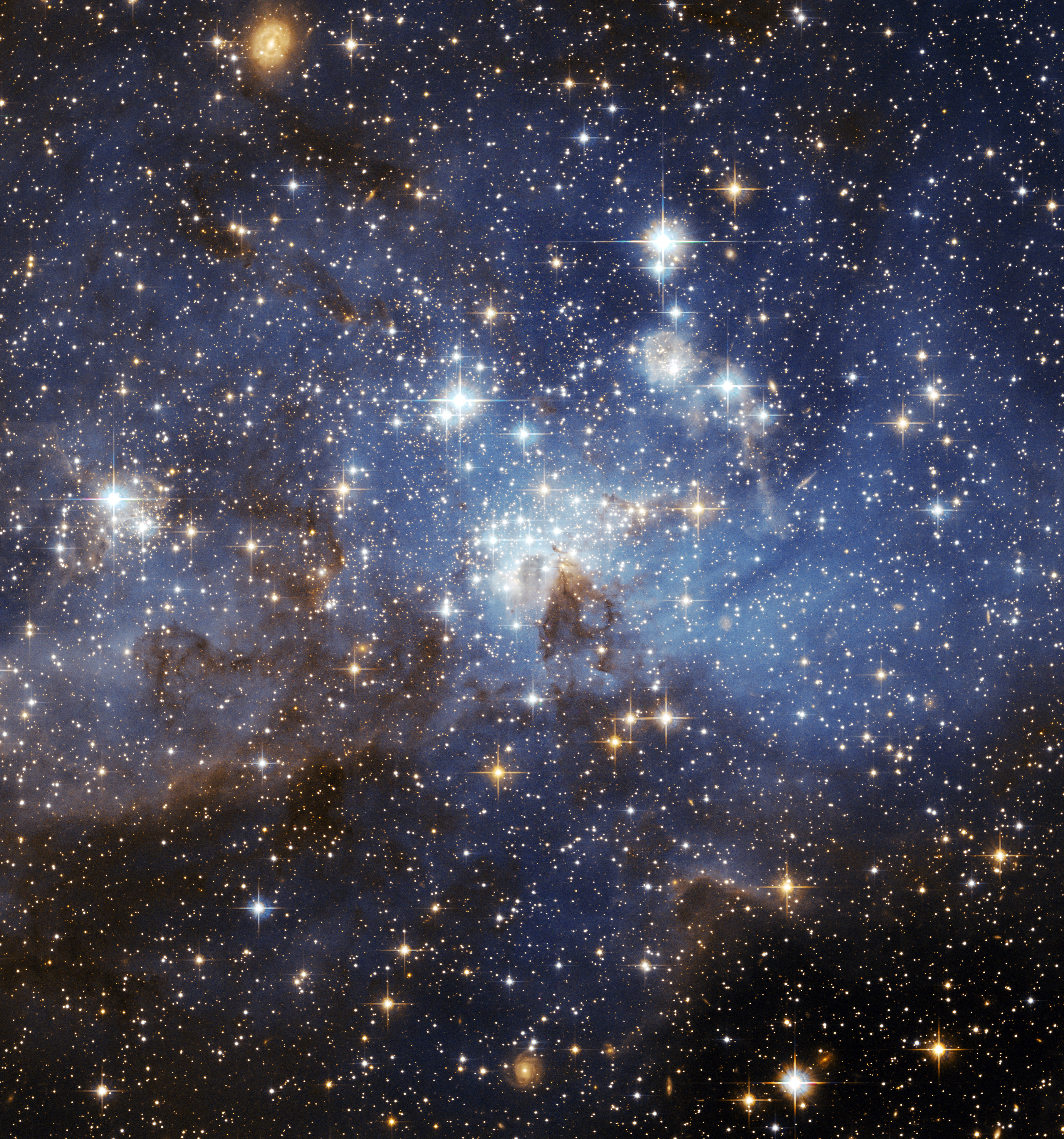
The Large Magellanic Cloud (LMC) is a nearby galaxy, and a satellite of the Milky Way. At a distance of 50 kiloparsecs (≈163,000 light-years), the LMC is the third closest galaxy to the Milky Way, after the Sagittarius Dwarf Spheroidal (~ 16 kiloparsecs) and the putative Canis Major Dwarf Galaxy (~ 12.9 kiloparsecs, though its status as a galaxy is under dispute) lying closer to the center of the Milky Way. The LMC has a diameter of about 14,000 light-years (~ 4.3 kpc) and a mass of approximately 10 billion Sun masses (1010 solar masses), making it roughly 1/100 as massive as the Milky Way. The LMC is the fourth-largest galaxy in the Local Group, after the Andromeda Galaxy (M31), the Milky Way, and the Triangulum Galaxy (M33).
In the past, the LMC was often considered an irregular type galaxy. However, it is now recognized as a disrupted barred spiral galaxy. The NASA Extragalactic Database, however, still lists the Hubble sequence type as Irr/SB(s)m). In reality, the LMC contains a very prominent bar in its center, suggesting that it may have been a barred dwarf spiral galaxy before being disrupted, likely by the gravitational tug of the Milky Way, resulting in the disruption of its spiral arms. The LMC's present irregular appearance is likely the result of tidal interactions with both the Milky Way and the Small Magellanic Cloud (SMC).
It is visible as a faint "cloud" in the night sky of the southern hemisphere straddling the border between the constellations of Dorado and Mensa, and it appears from Earth more than 20 times the width of the full moon.

1 Comments